
Your First RPG Isn’t About Getting It Right
- Jun 3
- 4 min read

Reflections from a lifelong adventurer
There’s a particular kind of pull that draws people into their first roleplaying game.
Sometimes it’s a friend—someone who can’t quite stop talking about it. They tell stories about past adventures as if they actually happened, about narrow escapes, unlikely victories, and characters who feel more like old companions than imaginary creations. Their excitement alone is often enough to make you curious.
Other times, it’s the setting that catches your attention. The promise of high fantasy kingdoms, distant planets, or a bleak and desperate future. Maybe it’s a world you already love—something familiar enough that stepping into it, even in a new way, feels irresistible.
Whatever the doorway is, there’s usually a moment where you think, “Alright… I’ll give it a try.”
And then you sit down at the table.
The Myth of “Being Ready”
There’s a particular kind of feeling I remember from my very first roleplaying game.
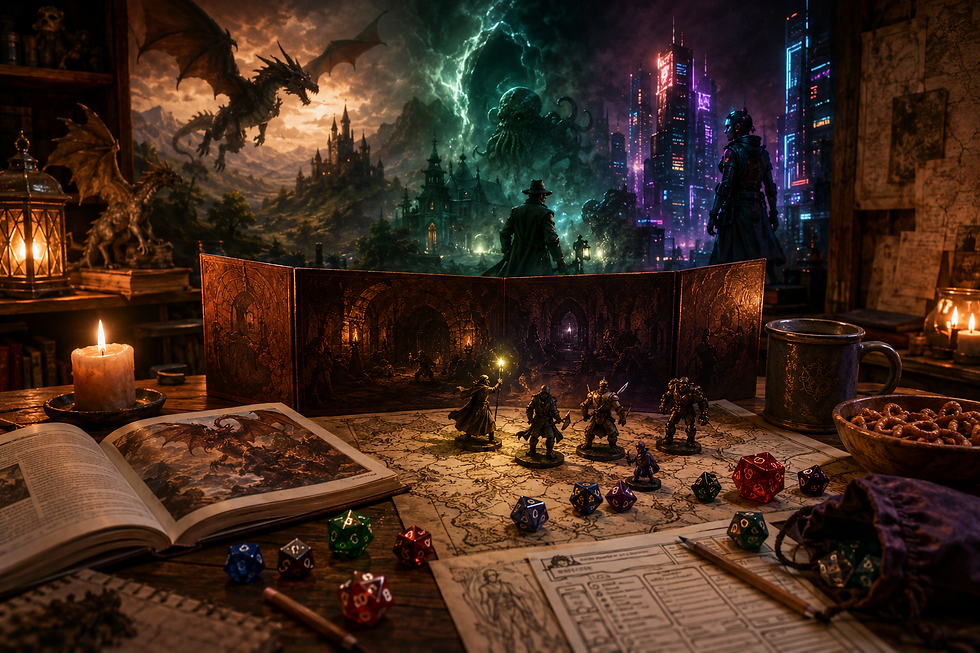
It was the late 1970s. A boxed set of Dungeons & Dragons—the basic set—sat on the table, promising something none of us had quite experienced before. There were maps, strange dice (The very first dice in my life where I had to take the included wax crayon and fill-in the numbers on it!), and rules that felt more like fragments of an ancient text than instructions for a game.
We didn’t fully understand what we were doing. Not even close.
But we played anyway.
And that, I think, is the part worth remembering.
Somewhere along the way, Role Playing Games picked up a reputation. People started to believe you had to prepare for them. That you needed to study the rules, understand every system, and build a character with careful precision before you ever sat down at the table.
That’s not how it started. And it’s not how it works best.
Back then, we didn’t optimize anything. We didn’t spend hours debating ability scores or perfect builds. Characters were sketched out quickly—sometimes clumsily—and then thrown headfirst into whatever danger the Dungeon Master had waiting for us.
It wasn’t polished. It wasn’t balanced.
It was fun.
When Character Creation Becomes a Barrier
Over the years, I’ve watched new players run into the same wall again and again.
They sit down, eager to try an RPG for the first time, and instead of playing, they find themselves buried in choices. Classes, subclasses, backgrounds, abilities, skills—each one feeling like it matters more than it probably does.
Before long, an hour has passed. Maybe two. Sometimes more.
And they haven’t actually played the game.
That’s often where the experience turns. What should have felt like stepping into an adventure starts to feel like filling out paperwork.
I’ve seen people walk away at that point, convinced RPGs just aren’t for them. Not because they didn’t like the game, but because they never really got to it.
The Games That Moved Faster
Not every RPG experience felt that way.
As the years went on, I found systems—some simpler, some just more flexible—that got to the point more quickly. Games where you could sit down, sketch out a character in minutes, and immediately be part of the story.
Those sessions always had a different energy.
People leaned in sooner. Laughed more. Took risks earlier. The focus wasn’t on whether your character was “built correctly,” but on what they were going to do next.
And that’s where RPGs come alive—somewhere between a bad decision and an unexpected roll of the dice.
The Good, The Bad, and The Ugly
Looking back across decades of playing, running, and watching games unfold, a pattern emerges. he good experiences almost always have the same qualities. People show up willing to try, willing to ask questions, and willing to let the game be a little messy. The rules are there, but they don’t get in the way. The story takes center stage.
The bad experiences tend to stall before they begin. Too much time spent preparing. Too much focus on getting everything right. Not enough actual play.
And the ugly ones—the ones that turn people away from the hobby altogether—usually come from pressure. Pressure to perform. Pressure to understand everything immediately. Pressure to treat the game like something you can fail.
That was never the point.
What You Should Expect Instead
If you’re new to tabletop RPGs, it helps to set a different expectation.
Your first session probably won’t be smooth. You’ll forget rules. You’ll make strange choices. You’ll ask questions that feel obvious in hindsight.
That’s part of it. Embrace it!
What matters is that you’re in the game. That you’re making decisions, reacting to the world, and seeing what happens next.
The character you create at the start isn’t the finished version. It’s just the beginning. The real details—the personality, the quirks, the memorable moments—those come later, shaped by the story itself.
A Better Way to Begin
If there’s one piece of advice I’d offer to any new adventurer, it’s this:
Start sooner.
Don’t wait until everything is perfect. Don’t feel like you need to understand every detail before you begin. Don’t let the creation process become the entire experience.
Sit down. Make something simple. And start playing.
The rest will follow.
An Invitation to the Table
RPGs have changed over the years. Systems have grown more complex in some places and more streamlined in others and there are more options now than ever before.
But the heart of it hasn’t changed since that first boxed set on the table.
A group of people. A shared story. A sense that anything could happen next.
At The Grand Adventurers Club, that spirit is what we hold onto. Not the idea of playing perfectly—but the idea of playing at all.
So if you’ve been hesitant to begin, or if your first attempt didn’t quite land the way you hoped, consider this your invitation to try again.
Pull up a chair.
This time, don’t worry about getting it right.
Just start the adventure.
Let us know your thoughts in the comments, or tell us what your first RPG experience was like, we would love to hear about it!
Comments